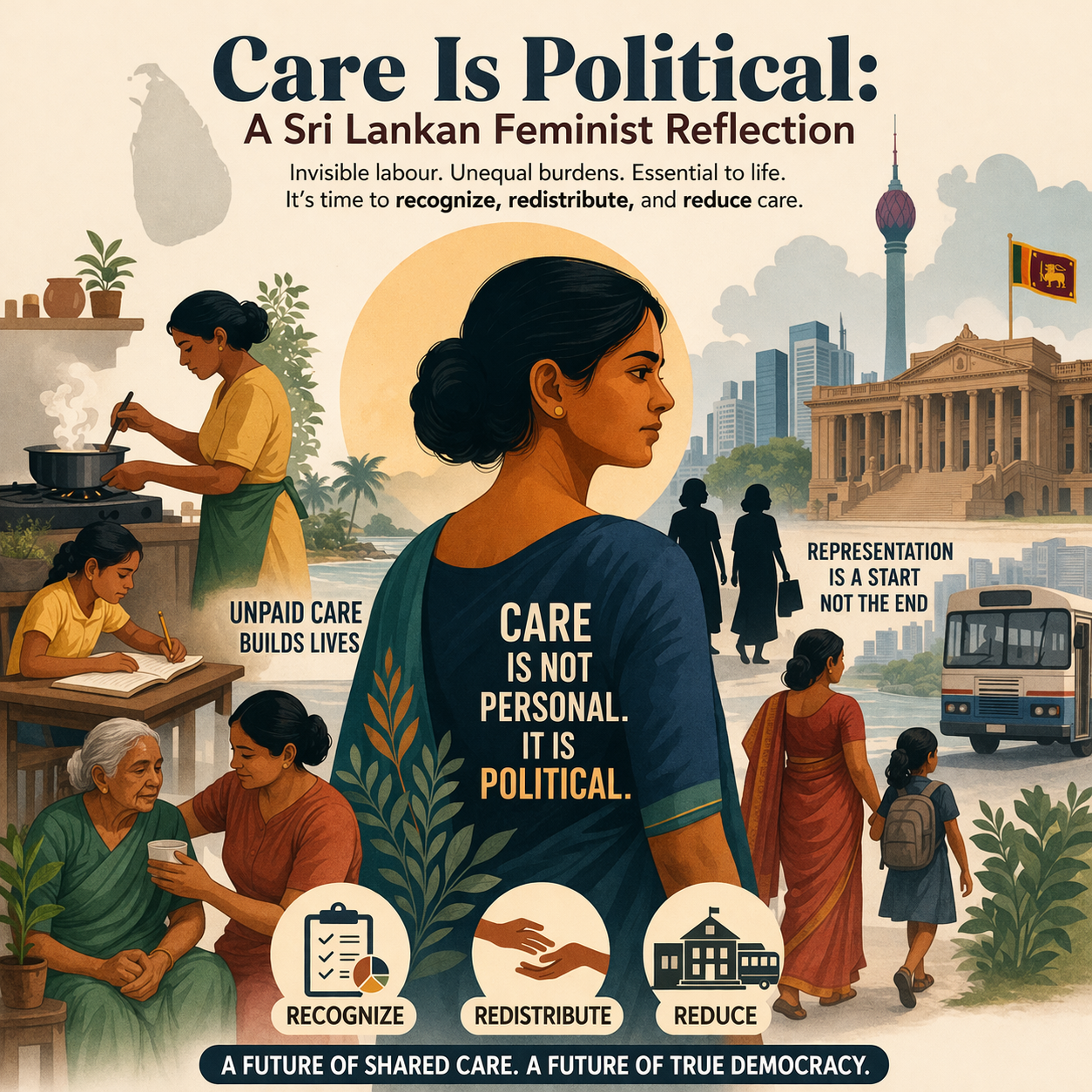
Care Is Political: “ A Sri Lankan Feminist Reflection”
Sumangala Anujan (Anusumi)
Every morning in Sri Lanka begins with invisible labour. Long before offices open or buses fill, women wake to cook, clean, care for children, and tend to elders. This work sustains families and communities, yet for decades it has been treated as natural, private, and economically irrelevant. Feminists have long insisted otherwise: care is not personal it is political.
That truth entered Sri Lanka’s corridors of power after the 2024 elections, which brought 20 women into Parliament and saw Dr. Harini Amarasuriya appointed Prime Minister. These shifts signal more than symbolic progress; they force a long-overdue reckoning with the gendered foundations of the economy and the state.
Across South Asia, women perform nearly 80% of unpaid care work, spending over six times more time on it than men. Sri Lanka reflects this imbalance sharply: 87.3% of women and girls over ten engage in household and care work, compared to 59.7% of men.
During the economic crisis of the early 2020s, this inequality deepened. As public services faltered healthcare, transport, education the state quietly relied on women’s unpaid labour to absorb the shock. Care became the emergency infrastructure.
The link between unpaid care work and political exclusion is direct. Women cannot participate equally in public life if they remain solely responsible for domestic labour. Sri Lanka’s post-2024 increase to nearly 10% women’s parliamentary representation is a breakthrough but representation alone is not liberation.
Across South Asia, even where quotas exist, women leaders continue to shoulder the mental load of care. They are expected to govern by day and manage households by night.
A feminist future demands that the state recognize care as essential infrastructure through recognition, redistribution, and reduction. This includes counting unpaid care work, redistributing care responsibilities through education and policy, and reducing the burden through public investment in childcare, eldercare, water, and transport.
Care is the heartbeat of Sri Lankan society. As the country rebuilds after crisis, true democracy will only emerge when care is shared across genders, households, and the state.
About Author: Sumangala is a Sri Lanka–based practitioner from Batticaloa with over 20 years of experience in the NGO sector, focusing on women’s empowerment and youth development. Her work engages deeply with conflict-affected and marginalized communities, bringing grounded feminist perspectives to issues of care, justice, and structural inequality.