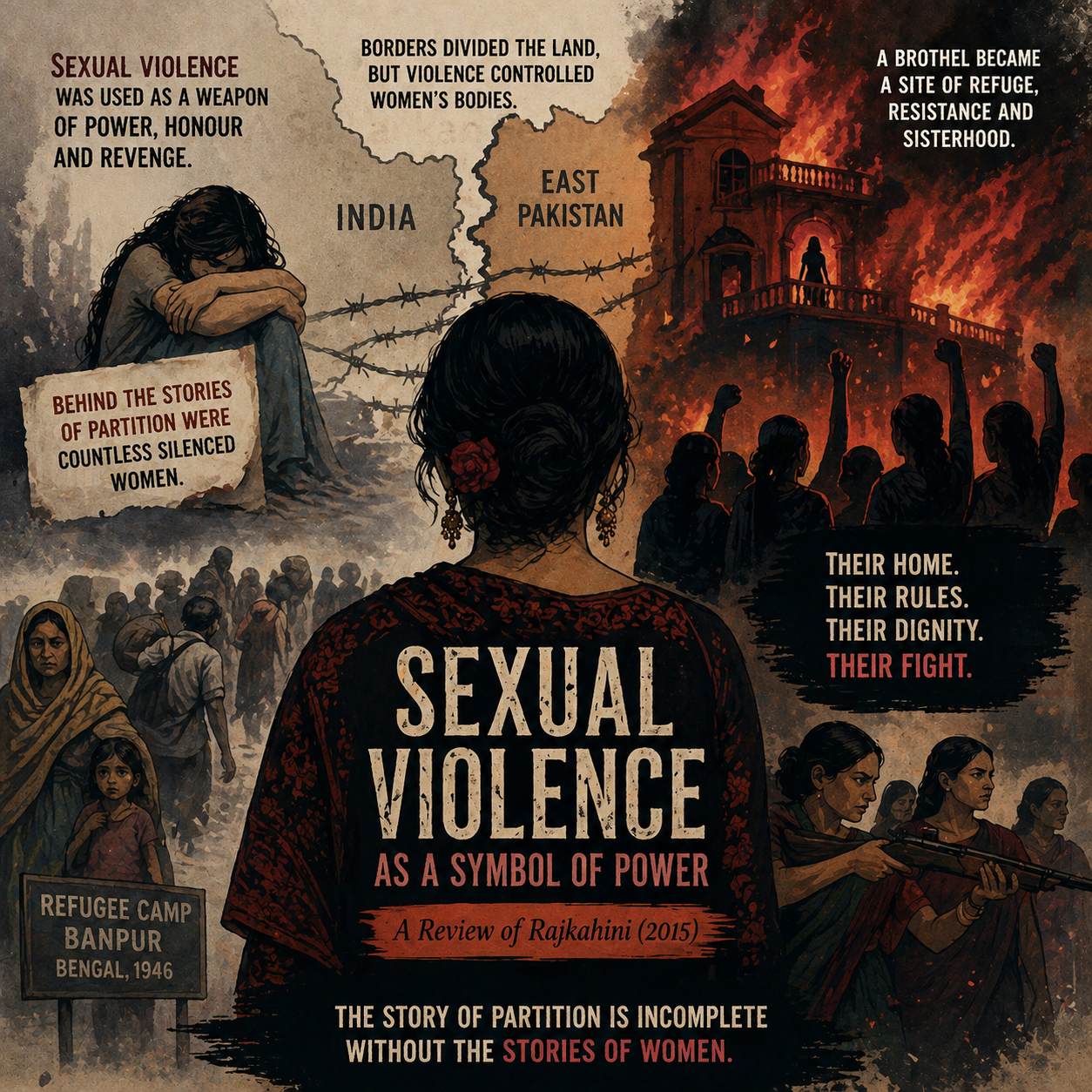
Sexual Violence as a Symbol of Power: A Review of Rajkahini (2015)
Aindri Dasgupta
The onset of the partition unleashed waves of communal tension and riots across the Indian subcontinent. Physical violence, humiliation and sexual assault became weapons wielded by both Hindu and Muslim communities to assert dominance, seek revenge, reclaim honour and retaliate against each other. Sexual violence against women became rampant as issues of shame, izzat (‘honour’) and policing of women’s bodies became the norm (Shrivastava 2022). Rajkahini (2015) by Srijit Mukherjee visits the story of a brothel that shared boundaries with both India and East Pakistan during the partition. The film opens with a haunting portrayal of a refugee camp in Banpur, Bengal, before partition (1946). The thousands of refugees that crowd the camps evoke the stories I heard from my grandfather, who migrated from Barishal, in erstwhile East Pakistan. He recalled severe food scarcity in the camps, where people would consume bhat er phen, the starchy water leftover from cooking rice to fill their stomachs. But such material deprivation was insignificant amidst all the chaos. Women’s traumatic experiences of gender-based violence were not acknowledged in mainstream conversations of the partition. Many women were killed by their own family, who feared dishonour if the women were captured and raped. According to common perceptions, women could not fight for themselves or be named as violent beings. Such narratives are meant to keep women within their aukat, their socially predetermined boundary, which defines them as non-violent (Butalia, 1998). In other cases, women were discarded because of the shame of being raped, as was depicted in the movie through the story of a young girl, Fatima, whose father, although initially worried about her well-being, abandons her at the brothel after she is raped. This experience was common to countless unnamed women in Butalia’s The Other Side of Silence (1998), who were disowned, hidden, or murdered in the name of purity and belonging. Thus, the brothel becomes a site of both refuge and exile. The film visualises what Butalia terms “the other side of silence”, which includes the stories of women who went through immense pain, trauma and their resistance as a result of the partition.
The scene cuts to a discussion between Sir Cyril Radcliffe and the Viceroy, where the latter says that they are “about to sever the arms of a nation, and it is going to be one bloody surgery”. This metaphor establishes the theme of disruption and amputation that is to follow. It is in this setting that we are introduced to the main character, Begum Jaan, a charismatic and independent woman who runs a brothel. This space soon becomes a contestation for resistance, female solidarity and the feeling of nation. Sen and Ilias, the officials vested with the duty of drawing the borders and putting check posts, attempt to evacuate them from the property. Although both of them reject violent means, as Begum Jaan and her community stand their ground, the officials hire goons, post which the film becomes rather violent and gory. The goons adopt extreme measures like creating a constant environment of terror, killing the pet dogs of the brothel and then secretly selling them as meat for consumption to the brothel, a rather barbaric gesture that mirrors the morality of a nation that had been brainwashed by the religious extremists. Begum Jaan describes her house as her vatan (homeland), she clearly specifies how everyone is equal and accepted here- “Hindu, Muslim, Brahmin and Achut”. She illustrates this by pointing out a Brahmin man who had just had intercourse with one of the Dalit sex workers. Centred around female characters, the film represents experiences of different women that led them to work at the brothel, and the diversity of caste and religion seems to be set up as “an interesting mix of period piece, counterfactual and subaltern history” (Sander, 2015). The secularity of this place is further displayed in the way the elder woman of the house worships Hindu idols despite Begum Jaan being a Muslim. When one of the workers at the brothel dies at the hands of the goons, he is cremated on the pyre, following Hindu rituals.
Begum Jaan, although very commercially hardheaded and seemingly devoid of much emotion, truly cares for the women at her brothel. As state power encroaches, she organises the women at the brothel to start training to shoot guns, a final attempt to protect their home. The house yet again emerges with a different meaning to them when Begum Jaan calls it an ashiyana (beloved home) where they could live with their heads held high. Ultimately, this house was a safe space for all the women who had been wronged by society, shielding them from the brutality beyond its four walls. Although the film depicts a certain communal harmony within the reality of the actual, brutally violent reality of the Bengal Partition, it fails to shed enough light on the world surrounding the brothel, which is far more complex.
The film ends with a gunfight between the women and the combined forces of the state and its hired goons. In their final moments, the women walk back into the house ablaze as they die with their house. A historic parallel in cinema with the practice of jauhar performed by Rajput queens, and with Begum Jaan’s previous declaration of wanting to die as a queen. As the government officials look at the site aflame from afar in dismay, it depicts the guilt of a nation pitted against each other. The burning house, thus, a metaphor for a burning nation.
References
Butalia, Urvashi. The Other Side of Silence: Voices from the Partition of India. Penguin Books India, 1998.
Sander, L. (2015, November 1). Eleven Heroines Does not a feminist film make: A review of Srijit Mukherji’s “Rajkahini.” The Caravan. https://caravanmagazine.in/vantage/eleven-heroines-not-feminist-make-review-rajkahini
Shrivastava, N. (2022). Genocidal Violence, Biopolitics, and Treatment of Abducted and Raped Women in the Aftermath of 1947 Partition in India. In Gender Violence, the Law, and Society: Interdisciplinary Perspectives from India, Japan and South Africa (pp. 23-33). Emerald Publishing Limited.
Shrivastava, N. (2022). Genocidal Violence, Biopolitics, and Treatment of Abducted and Raped Women in the Aftermath of 1947 Partition in India. In Gender Violence, the Law, and Society: Interdisciplinary Perspectives from India, Japan and South Africa (pp. 23-33). Emerald Publishing Limited.